California Buckeye (Aesculus californica): A poisonous California native.
By Roger Erismann, Casey Usher
Form, Function, and Taxonomy
The California buckeye is a deciduous, woody shrub or small tree, typically 12 to 36 feet tall, though exceptional specimens can exceed 40 feet. It displays a broad, rounded crown and distinctive palmately compound leaves with 5 to 7 finely serrated leaflets. Its showy floral display — dense, upright panicles of white to pale rose flowers up to a foot long — blooms from May through June, with some variation based on climate.
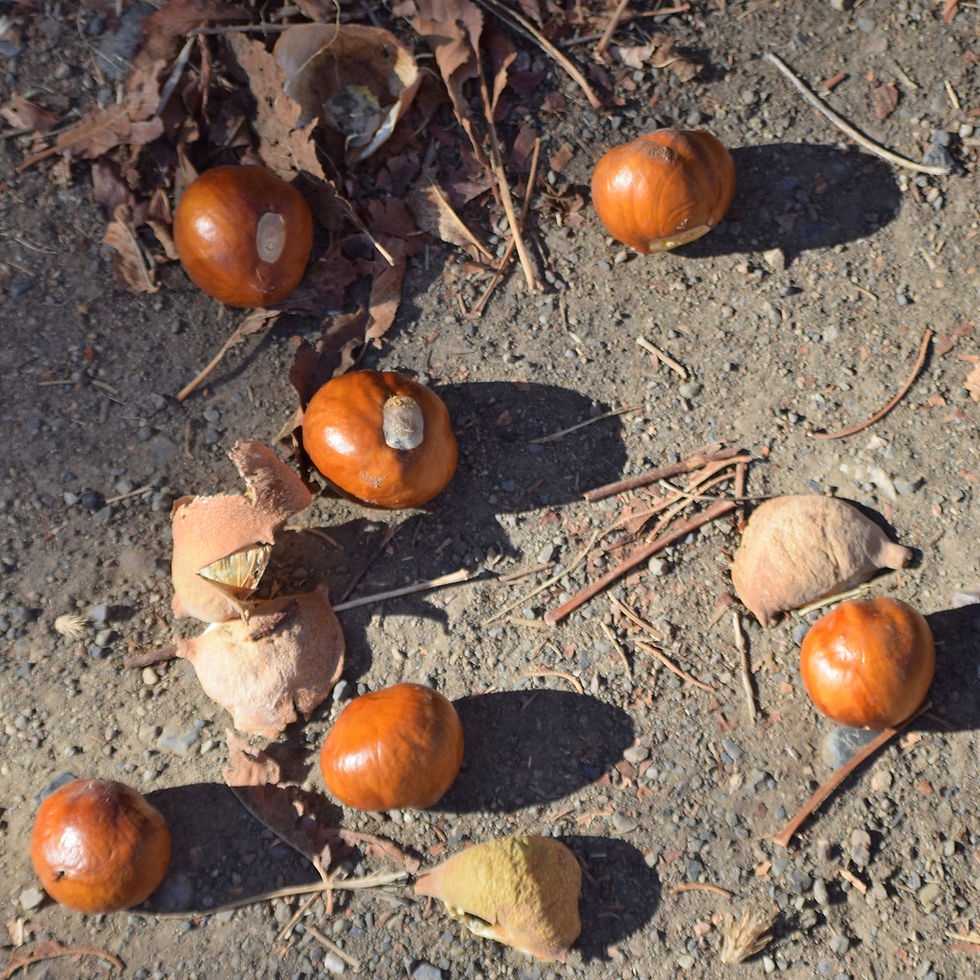
The tree’s fruits are leathery capsules that split open in fall to reveal large, smooth seeds — the “buckeyes” — which are visually striking but highly toxic. All parts of the plant contain aesculin, a glycoside toxic to many animals and especially to non-native honey bees.
Taxonomically, Aesculus californica is placed either in the Soapberry family (Sapindaceae) or the Buckeye family (Hippocastanaceae), depending on classification system used. The plant is endemic to California and parts of southwestern Oregon, making it a true native with deep evolutionary roots in the state’s ecology.

Habitat, Versatility, and Soil Tolerance
California buckeye’s ecological success is anchored in its Mediterranean climate adaptations. It thrives on dry slopes, canyon edges, and streambanks, typically below 6,000 feet, and is a defining component of oak woodlands and chaparral systems. It frequently coexists with blue oak (Quercus douglasii) and interior live oak (Q. wislizenii).
Its soil tolerance is notably broad — it grows in sandy, loamy, or gravelly soils with a pH range from 5.0 to 8.4, though it avoids saline conditions.
A deep taproot allows it to draw moisture from deep within the soil profile, and the plant has evolved a drought-avoidance strategy: it leafs out early in spring and drops its foliage by mid to late summer, going dormant during the driest months. This deciduous strategy is one of its greatest assets in climate-resilient planting, particularly in regions where seasonal water scarcity is the norm.

Community Roles and Ecological Relationships
While its toxicity may suggest ecological isolation, California buckeye in fact plays a surprisingly integrated role in its native ecosystems.
Pollination: The flowers are rich in nectar and attract a wide range of native pollinators, including bumblebees, butterflies, and hummingbirds. However, they are toxic to European honey bees, which can suffer deformities or colony failure after exposure. This limits the species' compatibility near apiaries or pollinator-dependent crops.
Wildlife interactions: Despite being toxic, young shoots and leaves are browsed by deer and rodents such as California ground squirrels. The seeds, however, are avoided by most wildlife due to their high saponin content.
Soil and slope stabilization: The plant’s extensive root system makes it valuable for erosion control in disturbed or sloped areas. It is often used in restoration efforts along streambanks and degraded chaparral.
Fire ecology: One of the buckeye’s standout ecological traits is its post-fire resilience. The species resprouts vigorously from its root crown after top-kill, often exceeding pre-fire biomass within just a few seasons. This makes it an effective survivor species in fire-prone landscapes.
Design Potential and Urban Considerations
California buckeye is not only functional — it’s visually stunning. It offers year-round interest for landscape designers and horticultural professionals:
Spring to early summer brings vibrant lime-green foliage and a cascade of fragrant, showy flowers.
Late summer through winter, the tree becomes sculptural, leafless, and eye-catching due to its thick branches and silver bark.
These aesthetic qualities, combined with low water requirements, make it an excellent choice for native, xeric, or Mediterranean-style landscapes. It’s especially useful in low-maintenance public spaces, residential plantings, and restoration projects. That said, designers should plan around its early summer dormancy — it won’t provide late-season shade — and its toxicity to humans and animals. Sites near playgrounds, livestock pastures, or apiaries may not be appropriate.
Propagation is straightforward. The seeds germinate readily without stratification when sown in the fall. Once established, California buckeyes are hardy and require little care aside from occasional pruning.

Ethnobotanical and Cultural Significance
California’s Indigenous communities, including the Pomo, Miwok, Yokut, and Chumash, used the buckeye extensively despite its toxicity. Notable uses include:
Food: After leaching and boiling to remove toxins, the seeds were ground into meal, especially when acorn supplies were low.
Fishing: Crushed seeds were used as a fish poison in still waters, where their saponins would stupefy fish for easy harvest.
Medicine and tools: Bark poultices were used for snakebites and hemorrhoids, while young branches served as fire drills or spindles.
These traditional uses reflect a deep ecological knowledge of the species’ chemistry and potential, developed over generations of close observation and experimentation.
Final Thoughts: A Tough Beauty Worth Knowing
California buckeye represents a model native species for climate-resilient design, fire-smart restoration, and ecological awareness. It thrives in some of the most challenging growing conditions California offers — from the dry chaparral to rocky oak woodlands — and remains a vital component of regional biodiversity.
References
University of California Agriculture and Natural Resources (UC ANR) : https://ucanr.edu/blog/real-dirt/article/finding-ecological-niche-buckeye
US Department of Agriculture (Forest) : https://www.fs.usda.gov/database/feis/plants/tree/aescal/all.html
US Department of Agriculture (Conservation) : https://www.nrcs.usda.gov/plantmaterials/capmcpg13492.pdf


Comments