Gray Pine : Rugged Sentinel of California’s Foothills
Updated: Aug 3, 2025
By Roger Erismann, Casey Usher
Form, Function, and Taxonomy
The Gray Pine—also known as foothill pine, bull pine or ghost pine—is one of California’s most distinctive native conifers. Often maligned for its irregular, “unkempt” appearance, Pinus sabiniana nevertheless represents a remarkable evolutionary response to some of the state’s most challenging growing conditions.

Mature trees typically reach 40 to 80 feet, with sparse, twisted crowns, long, silver-green needles, and multiple upright trunks that self-prune over time. The resulting high canopy offers minimal shade but reflects a characteristic adaptation to wildfire and drought.
Taxonomically, Gray Pine belongs to the three-needled subsection of Pinus and is endemic to California, with no recognized subspecies. The tree’s enormous cones—among the heaviest in the pine family—can exceed one foot in length and weigh over two pounds when green, posing a literal hazard to anyone standing underneath. Despite its unassuming looks, the tree’s form is highly specialized and serves important ecological and cultural functions.

Habitat Versatility and Soil Tolerance
Gray Pine thrives in an extensive but elevation-restricted range: generally between 100 and 6,000 feet, where it defines much of the California foothill landscape. It dominates dry slopes and ridges in the Sierra Nevada, Coast Ranges, and interior valleys, frequently co-occurring with blue oak (Quercus douglasii) in the classic oak-foothill pine woodland. It is also found in mixed stands with chaparral species, black oak, interior live oak, and Coulter pine, and extends as far as desert transition zones in the Mojave and Great Basin.
Its resilience is especially evident in its soil tolerance. Gray Pine is one of few trees that can flourish in both calcium-deficient serpentine soils and highly alkaline limestone. Where soil depth allows, it sends down a deep taproot; in more compacted substrates, it spreads shallow roots to intercept moisture. This adaptability makes it viable across a wide range of precipitation—from as little as 10 inches annually to over 70 inches in the wetter Sierra foothills.
Community Roles and Fire Ecology
In ecological terms, Pinus sabiniana plays a central role in transitional woodland habitats. Its seeds—nutrient-rich and calorically dense—are consumed by a wide variety of birds, rodents, and ungulates, including scrub jays, squirrels, California quail, and black-tailed deer. Despite being considered less valuable for commercial timber or livestock forage, the tree contributes significantly to wildlife food webs and soil stabilization.

Fire, while a threat to individual trees due to the species’ high resin and ether content, is also a key regenerative force. Mature specimens with thick bark and high crowns may survive low- to moderate-intensity fires. Post-fire conditions, particularly exposed mineral soils and heat-scarified seeds, improve germination rates and promote re-establishment. Historically, fire intervals in Gray Pine woodlands averaged 15 to 30 years. In the absence of fire, gray pine may even expand in some areas, potentially altering species composition.
Design Potential and Urban Use
While rarely used in formal landscape design, Gray Pine has potential for thoughtful ecological or restoration-based applications. Its rugged appearance, drought tolerance, and wildlife value make it well-suited for large-scale native plantings, erosion control projects, or as a character species in foothill-inspired designs. It is not shade-tolerant, so it performs best in open, sun-drenched sites.
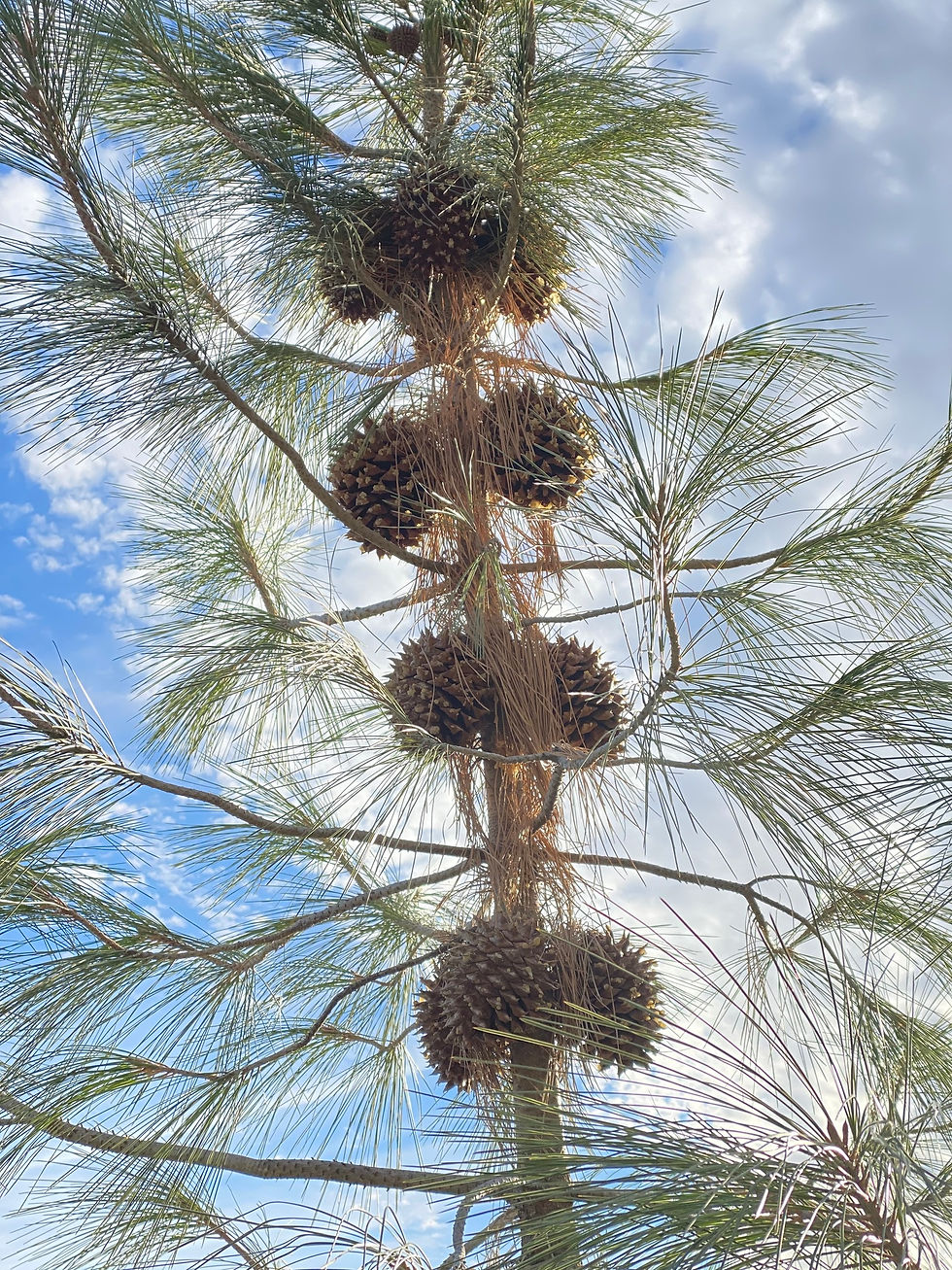
However, landscape use comes with caveats. The tree’s branching is relatively weak, its cones hazardous, and its resin flammable. It is also host to pests like dwarf mistletoe and susceptible to diseases such as pitch canker. Furthermore, its sparse canopy offers little shelter, limiting its function in urban shade planning. Still, in schoolyards or naturalized edges, the tree can offer educational value, especially for teaching plant adaptation, seed dispersal, and ethnobotanical history.
Conclusion
Gray Pine may not possess the symmetrical allure of its high-elevation cousins, but it is undeniably a species of great ecological, cultural, and botanical interest. From its enormous cones and serpentine-soil tolerance to its role in post-fire regeneration, Pinus sabiniana embodies resilience and regional character. For those who design, manage, or simply admire California’s rugged foothill landscapes, it’s a tree well worth knowing.
References
University of California Agriculture and Natural Resources : https://ucanr.edu/blog/real-dirt/article/gray-pine
US Department of Agriculture : https://www.fs.usda.gov/database/feis/plants/tree/pinsab/all.html
SelecTree. UFEI. "Pinus sabiniana Tree Record." 1995-2025. Cal Poly State University, San Luis Obispo. Accessed on Jul 24, 2025
Trees of Stanford : https://trees.stanford.edu/ENCYC/PINsab.htm


Comments