City Nature Challenge 2026 from Sacramento’s American River
Today I participated in the City Nature Challenge, a global community science event where people document wild plants, animals, fungi, lichens, and other organisms using iNaturalist. The challenge began as a friendly 2016 competition between Los Angeles and San Francisco and has since grown into an international urban biodiversity effort. (Los Angeles Times)
INaturalist observations are made by everyday people, but they can contribute to broader biodiversity records when they are documented carefully. The event encourages participants to photograph wild organisms during a four-day observation window and upload them to iNaturalist, where the community helps identify them. (iNaturalist)
My observations came from the American River Parkway in Sacramento, California, specifically around River Bend Park and Rossmoor Bar. These places are familiar to many of us as recreation spaces, but during a nature challenge they become something else too: living datasets.
At Hammerdirt I do tree assessments and develop software. Spending the day observing the Parkway was just like a day at work except I could take the time to appreciate the habitat the trees provide. Normally we are looking at the canopy or defects, or maintenance priorities. Today was about appreciating the structure, shade and shelter the trees provide.
The foothill poppy or tufted poppy:
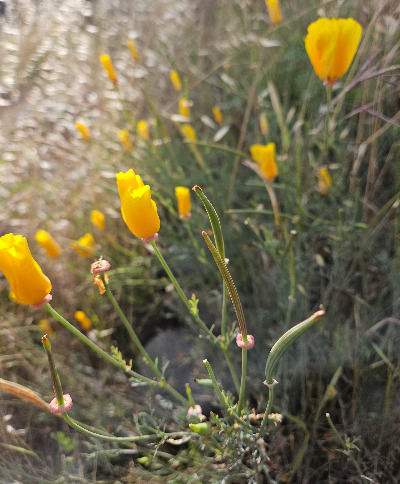
Eschscholzia caespitosa, commonly known as foothill poppy, tufted poppy, or collarless California poppy, is an annual herb native to western North America, ranging from Oregon through California to Baja California, where it is part of the chaparral plant community. It is similar in appearance to the California poppy and produces patches of divided foliage with thin, upright stems that can reach about 30 centimeters in height. Its flowers have bright orange to yellow petals, typically 1 to 2.5 centimeters long, followed by cylindrical seed capsules containing tiny, dark, netted seeds. Wikepedia, INaturalist
Lupinus or Bluebonnet

Lupinus, commonly known as lupin, lupine, or in some regions bluebonnet, is a genus of flowering plants in the legume family Fabaceae. The genus includes more than 199 species, with the greatest diversity found in North and South America. Lupines are usually herbaceous plants, though some are annuals, shrubs, or, in rare cases, small trees. They often have soft green to gray-green leaves divided into several leaflets, sometimes covered with fine silvery hairs. Their pea-like flowers grow on upright spikes in dense or open clusters and may be blue, purple, pink, yellow, or white depending on the species. After flowering, lupines produce seed pods containing several seeds, which often have a bitter taste due to naturally occurring alkaloids. Wikipedia, Inaturalist
Pipevine Swallowtail - Cateripillar

The pipevine swallowtail (Battus philenor), also known as the blue swallowtail, is a butterfly found across much of North America and into Central America. Adults are usually black with iridescent blue on the hindwings, while the caterpillars are often black or reddish. They live in a variety of habitats, including forests, open grasslands, woodlands, meadows, and gardens, especially in places where pipevine plants (Aristolochia) grow.
Pipevine swallowtail caterpillars feed on compatible Aristolochia species, also called pipevines. As they feed, they can store defensive compounds from the plants, making them toxic or unpleasant to predators. Adult butterflies feed on nectar from many different flowers. Although local citizen efforts have supported pipevine swallowtails in some West Coast neighborhoods, the species is not broadly protected by formal conservation programs, though it is listed as a species of special concern in Michigan near the northern edge of its range. Wikipedia, INaturalist


Comments